

In modern management, Human Resources has long since moved beyond the narrow confines of a “personnel department” and has become one of the most important strategic pillars of business. This is especially evident in a workplace like Baumer, where people and their motivation are the driving force behind success.
Tinatin Genebashvili, Baumer’s Human Resources Manager, combines administration with empathy and aligns business objectives with employee development. Having transitioned into talent management from the field of law, she now helps create an environment where employees become a vital foundation of the organization.
How has the art of people management evolved within the company, and what makes Baumer’s culture so distinctive? Tinatin Genebashvili shares her experience and insights.
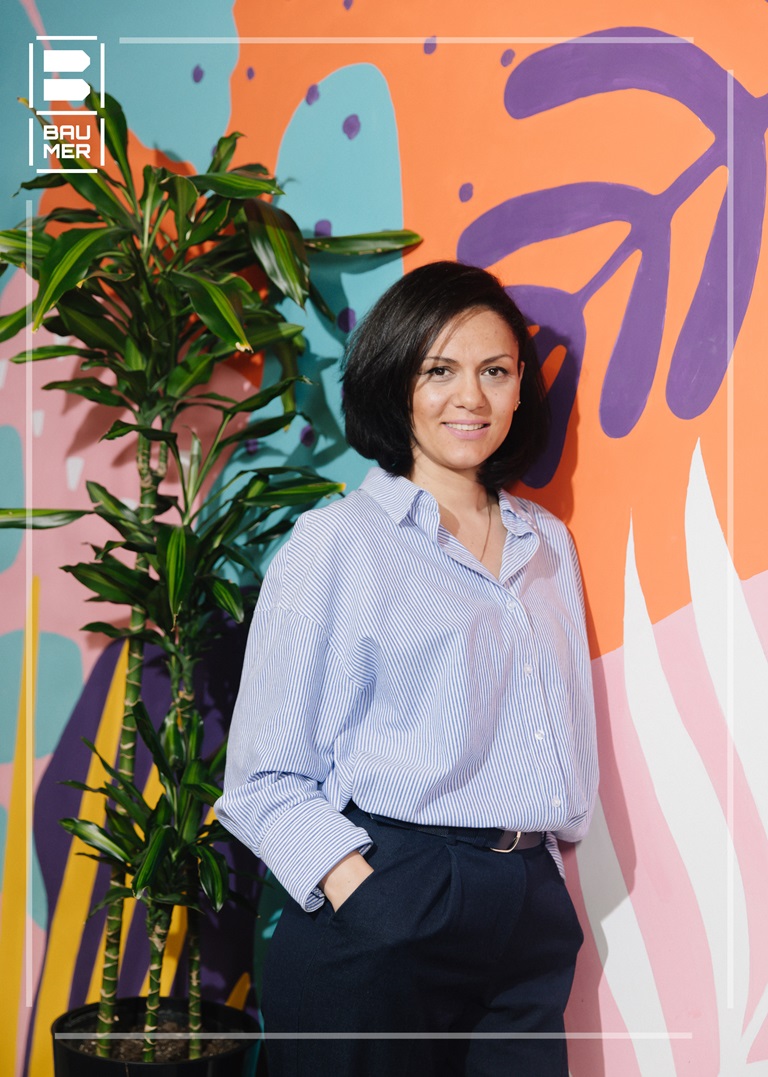
My childhood is associated with colorful, bright, and carefree days. I grew up close to nature, surrounded by books, in an environment where freedom of choice was the most important value. I always dreamed that every child could have the same happy and healthy upbringing that I enjoyed.
Following a family tradition, I initially decided to pursue a career in art and enrolled in the Academy of Arts. However, I soon realized that countless sheets of drawing paper, brushes, and watercolors were merely part of my journey of self-discovery. Walking around with paintbrushes tucked into my hair felt more like an image than a true calling.
Without telling anyone at home, I applied to a completely different field—the Faculty of Law. As it turned out, jurisprudence was much closer to my personality. When I finally shared the news with my family, to my surprise, no one objected. They viewed my relationship with art more as a phase of experimentation than as evidence of artistic talent.
After completing my first year at university, I began working in the Civil Cases Chamber of the Tbilisi City Court. Those were some of the happiest years of my life, during which I gained invaluable experience and formed lifelong friendships.
A few years later, I decided to try my hand at HR, and it turned out to be one of the best decisions I have ever made. It was exactly the field where I discovered my own “superpowers”: helping people find employment, uncovering hidden talents, supporting them, and contributing to their professional growth. This process became an inseparable part of my everyday life and continues to bring me immense satisfaction.
I have now been working in HR for ten years, although I had never previously worked in the engineering sector. One day, a friend mentioned that Baumer was looking for an HR Manager. The prospect of joining an engineering holding company seemed like a significant challenge, but I was captivated from the very first interview, and we practically reached an agreement immediately. I have now been a member of this team for a year and a half.
In the past, I viewed HR primarily as an administrative function, but reality proved otherwise. At Baumer, my role goes far beyond talent acquisition. It is a strategic partnership. Every day, I work to ensure that each employee has opportunities to grow, learn, and fully realize their strengths.
As an HR professional, my role is to serve as a bridge between management and employees. I do not simply manage processes—I listen to people. I witness and feel how our team members grow, discover their own paths, and become an integral part of the company’s success. After all, organizational progress is directly connected to employee development and the creation of an environment built on stability and trust.
I have seen many companies, including international organizations, but Baumer stands out. Here, no team member is left without support. Everyone can rely on their company. The atmosphere is incredibly vibrant, there is a strong sense of unity, and I can honestly say that this is a place I look forward to coming to every morning.
This is also my core value: maintaining a balance between the company and its employees, because it is within such an environment that trust is built and a genuine sense of stability is created.